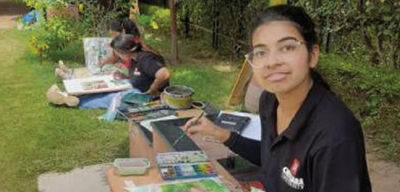
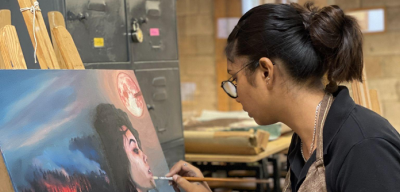
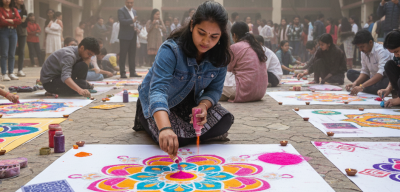
The painting will be created on the spot on a theme or subject that will be announced at
the start of the competition.
Participants will be given a total of 2 hours and 30 minutes to complete their artwork.
The painting must be made on half imperial size drawing paper (22” × 15”).
This paper will be provided by the host institute.
Participants may use any one media such as Acrylic Colours, Water colours, Poster
colours,
Pastel colours, Oil colours, etc.
Participants must bring their own art supplies, including brushes, colours, palettes,
containers, and any other required tools.
Only the drawing sheet will be provided by the host institute.
Participants are advised to bring their own drawing boards or easel as per their choice.
The use or possession of mobile phones and other digital devices is strictly prohibited
for
participants throughout the duration of the event.
Paintings will be evaluated on criteria such as Relevance to Theme, Creativity and
Originality,
Composition and Layout, Colour Harmony, Technique, & Overall Aesthetic Appeal.
Collage
Only one entry per university is allowed.
The collage will be created on the spot on a theme or subject that will be announced at
the start of the competition.
The collage must be made on half imperial size drawing paper (22” x 15”).
This paper will be provided by the host institute.
Participants will be given a maximum of 2 hours and 30 minutes to complete their
collage.
Collages must be prepared only using materials from old magazines and newspapers.
Participants must bring their own materials, including adhesive (pasting material),
old magazines/newspapers, and any other required items.
Use of scissors, cutters, blades, or any sharp cutting tools is strictly prohibited.
All tearing/cutting must be done by hand.
The use or possession of mobile phones and other digital devices is strictly prohibited
for participants throughout the duration of the event.
Collages will be evaluated on criteria such as Relevance to Theme, Creativity and
Innovation,
Neatness and Craftsmanship, Composition and Layout & Visual Impact, and Aesthetic
Appeal.
Poster Making
Only one entry per university is allowed.
The posters will be created on the spot on a theme or subject that will be announced at
the start of the competition.
Participants will be given a total of 2 hours and 30 minutes to complete their artwork.
The poster must be made on half imperial size drawing paper (22” x 15”). This paper will
be provided by the host institute.
Participants may use any one media such as Acrylic Colours, Water colours, Poster
colours, Pastel colours, etc.
Participants must bring their own art supplies, including brushes, colours, palettes,
containers, and any other required tools. Only the drawing sheet will be provided by the
host institute.
Participants are advised to bring their own drawing boards or easel as per their choice.
The use or possession of mobile phones and other digital devices is strictly prohibited
for participants throughout the duration of the event.
Posters will be evaluated on criteria such as Relevance to the Theme, Creativity and
Originality, Visual Impact and Presentation, Clarity of Message / Visual Communication,
and Overall Composition and Neatness.
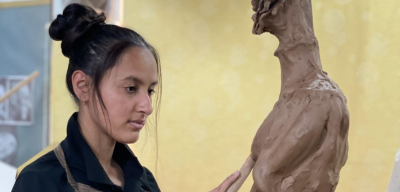
Clay modelling
Only one entry per university is allowed.
The clay model must be created on the spot, based on a theme or subject that will be
announced at the start of the competition.
Participants will have a total of 2 hours and 30 minutes to complete their artwork.
The maximum permissible size of the clay model is 12 inches × 12 inches × 12 inches (30
cm × 30 cm × 30 cm).
Participants may bring clay modeling tools (e.g., shaping tools, rolling pins, modeling
knives – all non-electric and hand-held); water sprays or small bowls for softening
clay; cloths/rags for cleaning; and protective aprons or gloves.
Participants are allowed to use armatures and the necessary tools for erecting them.
Participants are required to bring a wooden plank or plywood sheet with minimum
dimensions of 2 feet by 2 feet and a thickness of at least 12 millimetres, to be used as
the base for their clay model.
The following are strictly prohibited: electric or battery-operated tools, heating
equipment, hair dryers, or any powered tools; pre-molded or pre-designed parts; external
decorations; use of paint, glitter, sequins, fabric, or any other embellishments; and
clay types other than those provided.
The use or possession of mobile phones and other digital devices is strictly prohibited
for participants throughout the duration of the event.
Clay models will be evaluated based on the following criteria: relevance to the theme,
creativity and originality, technique and detailing, structural stability and aesthetic
appeal, and finish.
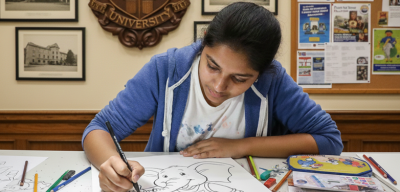
Cartooning
Only one entry per university is allowed.
The cartoon will be created on the spot on a theme or subject that will be
announced at the start of the competition.
Participants will be given a total of 2 hours and 30 minutes to complete
their artwork.
The cartooning must be made on half imperial size drawing paper (22” x 15”).
This paper will be provided by the host institute.
Participants may use any one media such as Acrylic Colours, Water colours,
Poster colours, Pastel colours, etc.
Participants must bring their own art supplies, including brushes, colours,
palettes, containers, and any other required tools. Only the drawing sheet
will be provided by the host institute.
Participants are advised to bring their own drawing boards or easel as per
their choice.
The use or possession of mobile phones and other digital devices is strictly
prohibited for participants throughout the duration of the event.
Cartooning will be evaluated on criteria such as Relevance to Theme, Creativity
and Originality, Artistic Composition and Design, Technique, Use of Medium,
and Overall Visual Impact.
Rangoli
Only one entry per university is allowed.
Participants will be required to create a Rangoli design based on a subject, theme, or
topic announced at the start of the event.
Participants will be given a total of 2 hours and 30 minutes to complete their artwork.
The maximum permissible size for each Rangoli design is 4 feet × 4 feet (i.e., 4 feet
diameter in case of circular rangoli) while the rangoli must not be smaller than 2.5
feet × 2.5 feet (i.e., 2.5 feet diameter in case of circular rangoli). Rangoli must be
created within and on the space allotted by the organisers.
Participants must bring their own materials.
Participants may use permitted medium for their Rangoli. Acceptable materials include:
Rangoli powders or colours, flower petals, coloured sawdust, or food grains (e.g., rice,
lentils).
Pasting/gluing of materials is strictly prohibited.
The use of dyes, stencils, moulds, mechanical tools, or any other aids is not permitted.
All work must be done freehand.
Participants may draw from traditional forms such as Mandna, Alpana, Alekhan, Kolam,
Rangoli, or others, with interpretations allowed in freehand, pictorial, or descriptive
styles.
The use or possession of mobile phones and other digital devices is strictly prohibited
for participants throughout the duration of the event.
Rangolis will be evaluated on criteria such as relevance to the theme, creativity and
innovation, design and composition, neatness and precision, colour harmony and aesthetic
appeal.